Passing a close protection course starts long before day one.
The course itself is demanding and condensed, and you are being weighed up from the first morning. The people who do well are rarely the fittest in the room, or the ones with the biggest military background. They are the ones who turned up sorted. Paperwork done, first aid in the bag, kit squared away, head in the right place.
That part is the bit you actually control. Here is how to get it right before you walk through the door.
Sort the paperwork first
Start here, because it is the thing most likely to cost you your place.
Before you can hold an SIA close protection licence you have to be eligible to apply for one. Check that now, not later: you need the right to work in the UK, and the SIA runs criminal record checks as part of licensing. The course gets you the qualification. The licence itself is a separate application and fee to the SIA once you have passed, so keep a bit back in the budget for it.
If you are coming onto a selective course, there is usually an application and interview before you are offered a place. Every provider runs this differently, so ask yours what their process looks like and start that conversation early.
Have your documents ready well before day one. Turning up without them is an avoidable way to start on the back foot. As a rule, get the following sorted:
Photo ID: a valid passport, or a UK photocard driving licence.
Proof of address: a recent utility bill, bank statement or council tax letter, usually dated within the last three months.
Right to work in the UK: your passport, or a share code and supporting document if you are not a British or Irish citizen.
Your National Insurance number.
Your valid first aid certificate: the one covered in the next section.
Two passport-sized photos: you will need these for the SIA licence application that follows, so it is easier to have them ready.
Any enrolment or medical declaration forms your provider sends you, completed and signed.
Your provider will confirm exactly what they need and when, so follow their list over this one if the two differ. Bring originals rather than photocopies unless you are told otherwise, and note that the SIA licence application you make after passing has its own specific list of accepted ID documents, which you can check on gov.uk.
Get your first aid in the bag
This one trips up more people than anything else, so read it twice.
You must already hold a valid first aid qualification before you start the course. It is not something you pick up on the way through. It also needs to stay valid for at least another twelve months from the point you train. Leave it to the last minute and you can lose your place on a course you have already paid for.
The minimum is usually a Level 3 Emergency First Aid at Work, and a full Level 3 First Aid at Work is better still and covers you comfortably. Your provider will confirm exactly which qualification they accept and by when, so check with them, then book it early, get the certificate in hand and bring proof with you. Sort it sooner rather than the week before.
Get your ACT done before you arrive
Most providers will ask you to complete the ACT Awareness e-learning before your course date, so check whether yours does and get it ticked off early rather than scrambling the night before.
It is free, takes about an hour, and comes from Counter Terrorism Policing. Threat awareness runs right through close protection work and it is built into the qualification now, so treat it as part of the job rather than a box to tick. It gives you a bit of grounding before you walk in, and instructors can always tell who did the reading and who did not.
Be straight about the medical side
Be honest on the medical forms. All of them.
Declare any conditions, old injuries, or anything that affects you under exertion or stress. Instructors would far rather know on the first morning than find out when you are folded over halfway through a drill. It is not a mark against you. It lets them look after you properly.
If you take any medication, bring enough for the whole course and let the staff know. The days are long, the starts are early, and there is not much downtime built in. Sort your sleep and hydration in the days before you arrive, not just once you are there. Turning up already run down makes a hard week harder. Every provider has its own medical forms and declarations, so complete whatever yours sends you in full and ask if anything is not clear.
Get fit, and look it
This one goes past the course and into the job itself. Looking fit and strong is part of the work.
A client is putting their safety in your hands. If it all goes wrong, you are the one getting them out of there, and the way you carry yourself tells them whether you can, long before you ever have to prove it. Someone who clearly looks after themselves gives a principal confidence. Someone who does not does the opposite. Fair or not, that read gets made in the first few seconds, so show them you can look after them because you look after yourself.
Show them you can look after them, because you look after yourself.
The course will test it too. Most CP courses are not a secret PT test, but they are long days on your feet. Walking for miles, standing for hours, foot drills, in and out of vehicles over and over, carrying kit and staying switched on when you are knackered and it is hammering down. Low base fitness is what catches up with you by day three, when the thinking goes sloppy because the body is flagging.
You have time to sort it. Steady cardio, some walking with a bit of load on your back, basic strength work and proper sleep will do more than any last-minute heroics. Turn up fit enough to keep going all day, and looking like someone a client would trust to stand between them and trouble.

Get the wardrobe right
In this industry, the suit is your uniform. A lot of close protection work is done smart, so a well-fitted business suit you can actually move in is money well spent. Dark, plain, nothing flashy that pulls the eye.
Shoes matter more than people think. Smart, yes, but ones you can stand and walk in all day, and broken in before you arrive. Blisters on the first morning make for a very long week. Plain shirts, a tie, a belt, all tidy.
Pack smart-casual and some darker, low-profile layers as well, because not every task is suited and you will likely work both. Check your provider's dress code before you pack rather than guessing. However you turn up, look the part. First impressions are part of the job you are training for.
Square away your kit
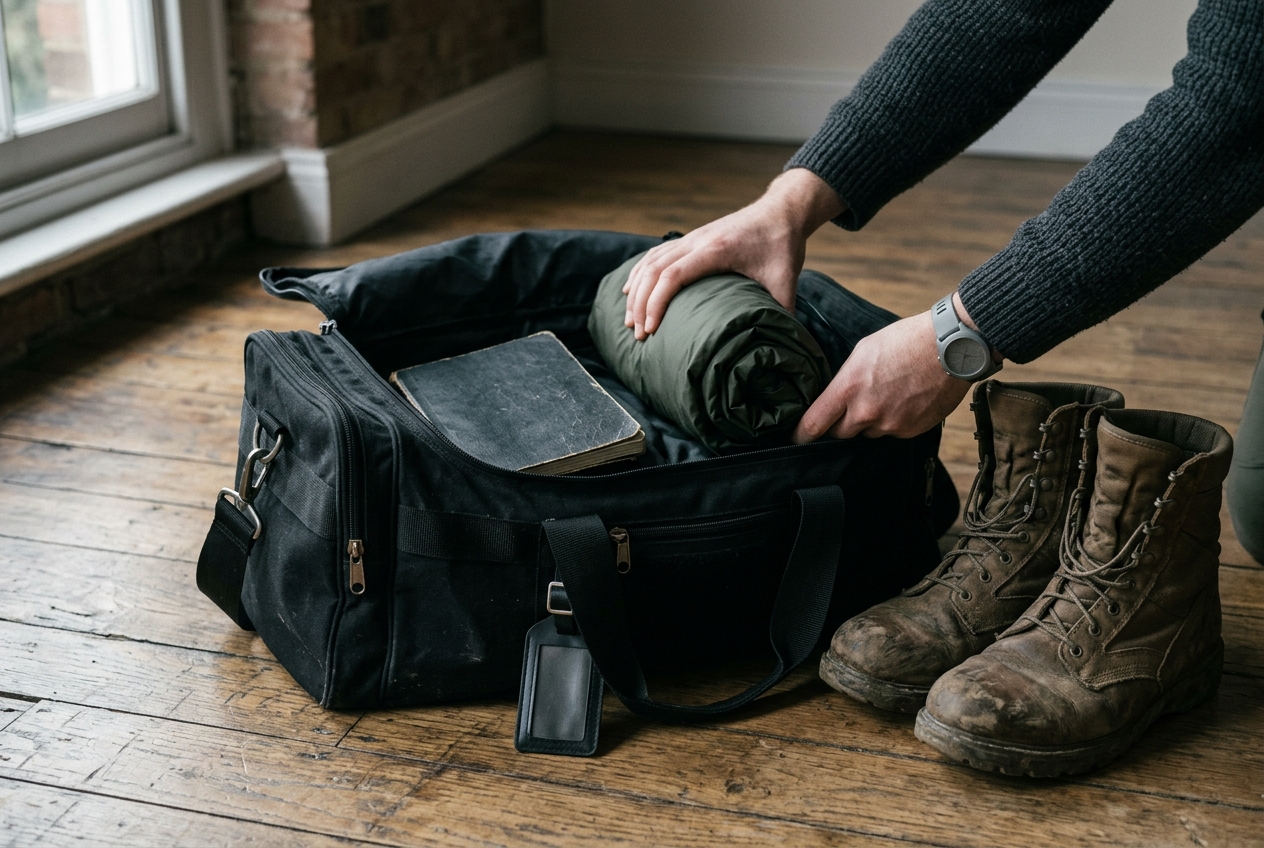
Your provider will send a kit list. Follow it to the letter. If they have not sent one, ask for it.
A few things worth having whatever the list says: a notebook and a couple of pens, because you will write a lot and "I will remember it" never works. A reliable watch. Your phone and charger. A washbag and a bag you can live out of for the duration. A weatherproof layer, because drills run rain or shine.
Comms kit, earpieces and vehicles are almost always provided, so do not go buying an earpiece off the internet to look the part. The flip side matters too: do not turn up with a boot full of tactical gear you were specifically told to leave at home. Bring your documents, your first aid certificate, and what you were asked for. Nothing more, nothing less.
Get your head right
This is the quiet one, and it matters more than any of the kit.
A CP course is also an extended interview. Instructors talk to each other, the industry is smaller than it looks, and your name travels further than you do. Turn up early, switched on, humble, and easy to work with. Take the feedback without sulking, do the admin without being chased, and back your teammates.
Your name travels further than you do.
The person who is reliable and coachable gets remembered long after the one who was loudest in the room. That reputation starts on day one of your course, not on your first paid job.
The bottom line
The course will be hard. That part is out of your hands. What you can sort is turning up ready for it.
Paperwork done, first aid in the bag, fit enough for the long days, kit squared away, head screwed on. Get all that done before you arrive and you free yourself up for the only thing that counts once you are there: learning the job properly, instead of forever playing catch-up.
If you are weighing up where to train, our own Close Protection Programme runs over eighteen days out of Battersea Power Station, by application and interview, six to an intake. If you would rather get a feel for the work first, the one-day Close Protection Skills and Familiarisation Day puts you alongside a working team for a day. The first aid you will need before any of it, we run that too.
Thinking about it but not sure where to start, or whether it is even for you? You do not have to be a member to ask. Email info@theopscon.com or WhatsApp +44 7386 457707, and we will talk it through. No hard sell.
At a glance
Prep starts weeks before day one. The people who do well are the ones who turned up sorted, not the fittest or the most experienced.
Sort the paperwork first. Check you are eligible to apply for an SIA licence, have your ID and documents ready, and budget for the separate licence application and fee after you pass.
Get your first aid done early. You must already hold a valid qualification before the course starts, valid for at least another twelve months. Level 3 Emergency First Aid at Work is the minimum, full First Aid at Work is better.
Complete the free ACT Awareness e-learning before your course date. Most providers ask for it, and threat awareness runs right through the job.
Be honest on the medical forms, bring any medication you need, and turn up rested and hydrated rather than run down.
Get fit, and look it. A client trusts the person who clearly looks after themselves, and the course is long days on your feet. Low base fitness catches up with you fast.
Get the wardrobe right. A well-fitted, plain business suit, comfortable broken-in shoes, and low-profile layers. Check the dress code before you pack.
Square away your kit to the provider's list. Notebook, watch, weatherproof layer, documents. Comms and vehicles are provided, so do not over-buy.
Get your head right. The course is an extended interview. Early, switched on, humble and coachable gets you remembered for the right reasons.