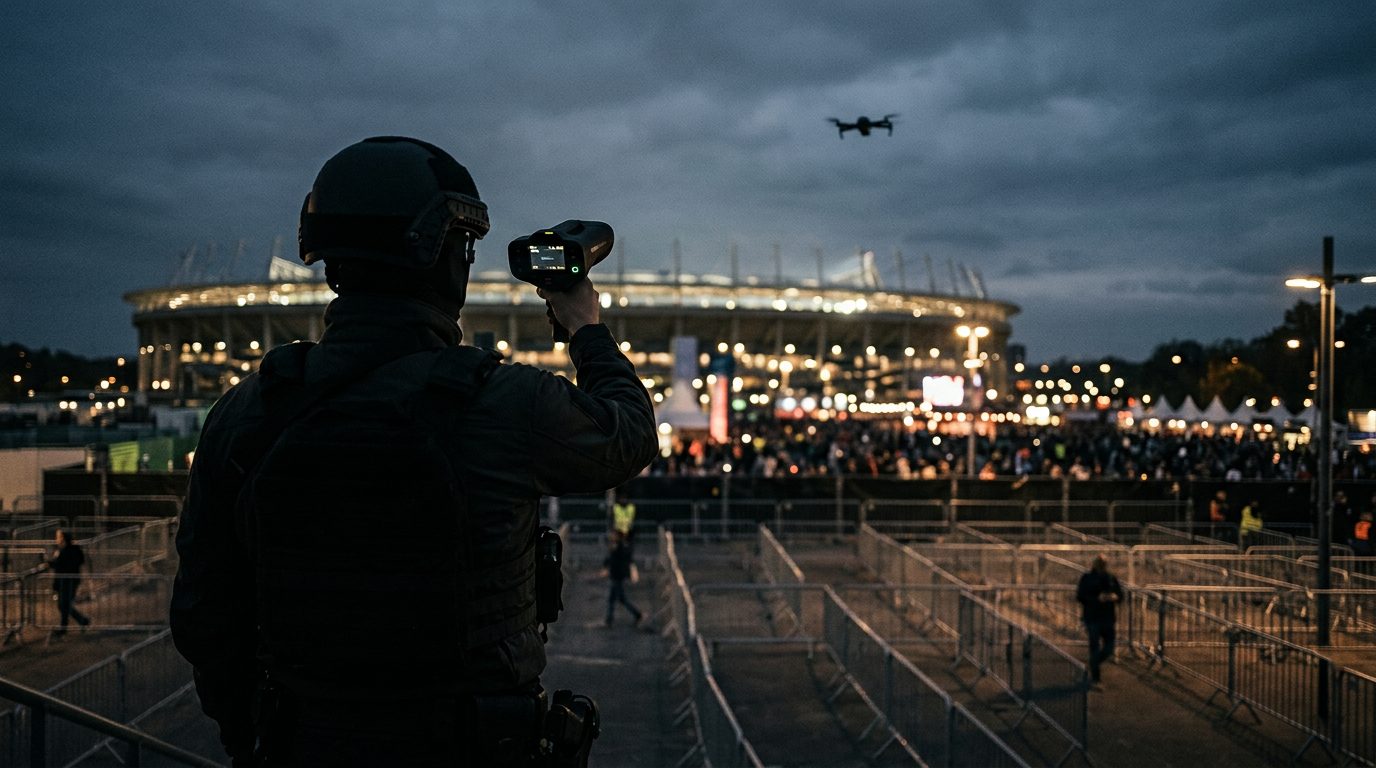
The World Cup runs to 19 July, and the security operation is into its last fortnight. Stadiums are covered — designated no-drone zones with temporary flight restrictions, and layered detection and response (FAA). The gap is everywhere else.
In early-June testimony, DHS Secretary Markwayne Mullin called counter-drone one of the areas his department is 'struggling with', and acknowledged federal agencies were not fully ready across all eleven US host cities, singling out fan zones and the soft areas outside stadiums. A 76-day government shutdown earlier in the year delayed roughly 250 million dollars in FEMA security grants and slowed readiness (DroneLife). The capability is real but uneven: officials had earlier grounded eight drones at the Miami Formula One Grand Prix and twelve at the Augusta golf (DroneLife).
Detection is being reinforced. Robin Radar's IRIS 3D system — around a 12-kilometre range, set up in under fifteen minutes — is deployed by DHS components alongside state and local agencies, building on its use at the 2024 Paris Olympics (Robin Radar).
For close-protection and event teams the read is simple. Inside the stadium footprint, the drone problem is largely handled and largely someone else's. The residual risk sits in the grey space a principal actually moves through — arrivals, fan zones, hotels and transport nodes outside the protected airspace — where detection is thinner and response slower. Plan movement on the assumption that a small drone overhead in those areas may not be tracked in real time, and build that into route and timing choices for the run-in to the final.