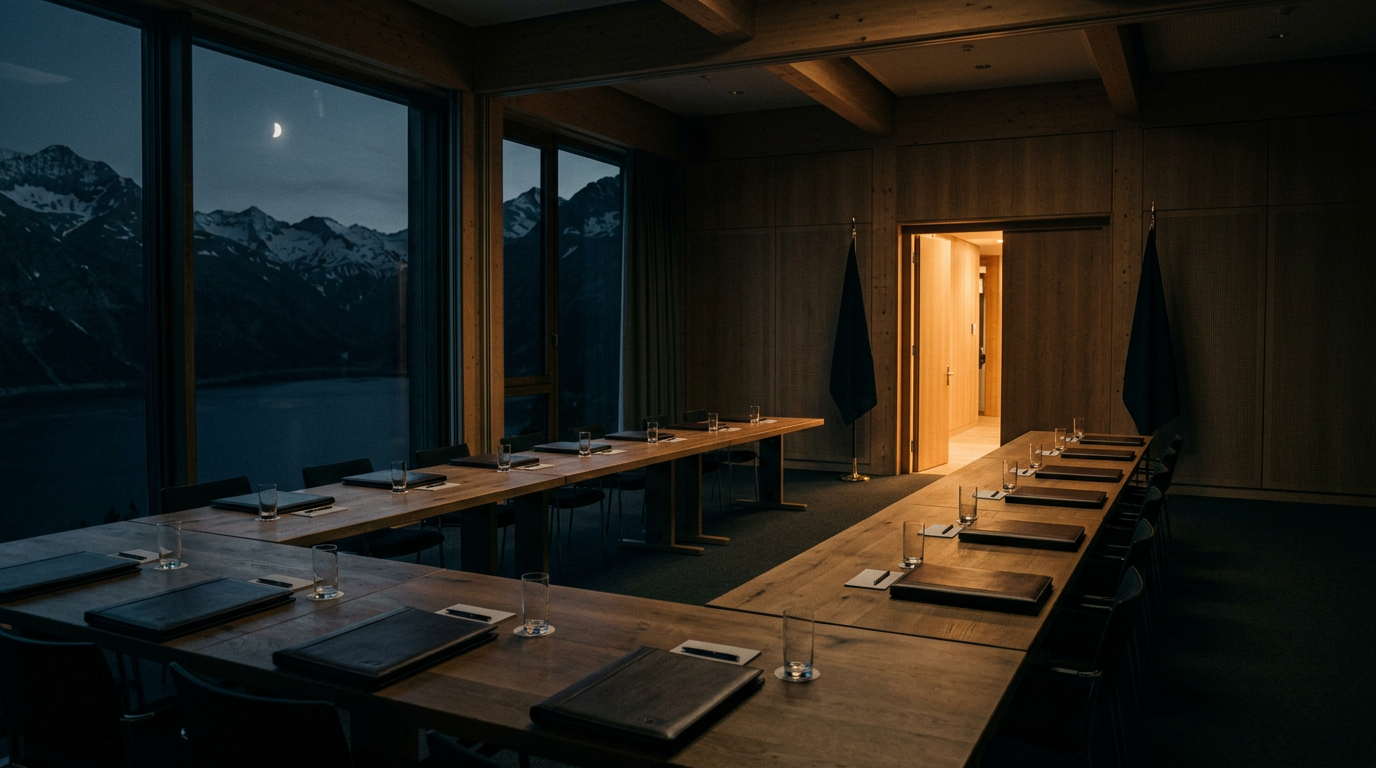
The first round of high-level US–Iran talks at the Bürgenstock, above Lake Lucerne, closed early on Monday 22 June. The mediators — Qatar and Pakistan — issued a joint statement citing "encouraging progress", a road map to a final deal inside 60 days, and a communication line to avoid incidents in the Strait of Hormuz. It follows the memorandum the two sides signed the previous week.
This is a foundation, not a settlement. US Vice-President JD Vance, leading a delegation alongside envoys Steve Witkoff and Jared Kushner, framed it plainly: "We haven't built the house, but we've laid a successful foundation." Iran was represented by Parliament Speaker Mohammad Bagher Ghalibaf and Foreign Minister Abbas Araghchi. The 60-day window is reported to cover Iran's nuclear programme and the Israel–Lebanon war, with Washington signalling a temporary easing on Iranian oil distribution over the same period.
- **The strait is contested signalling, not a blockade.** Iran's IRGC declared Hormuz closed on Saturday 20 June over the fighting in Lebanon. US Central Command rejected it the same day, reporting 55 merchant ships transiting and passage "intact". Traffic dipped over the weekend — one tracking firm logged 12 vessels on Sunday against 35 the day before, with several inbound ships running dark — but it never stopped, sanctioned tankers included. - **The official threat reading came down, not up.** UKMTO's Joint Maritime Information Centre lowered the Strait of Hormuz threat to "moderate" on 20 June, from "substantial" two days earlier; its 18 June advisory (JMIC 009-26) had already declared the strait open. It warned that mines remain in the area and to expect naval presence while clearance continues, with the southern lane near Oman open day and night. - **For operators:** treat the deal as interim and Lebanon as the live trigger. Route Gulf transits via the southern Omani lane, stay inside the UKMTO/NCAGS reporting system, and read the AIS-dark uptick and continued sanctioned-tanker movement as elevated identification and seizure risk — not as a return to normal.