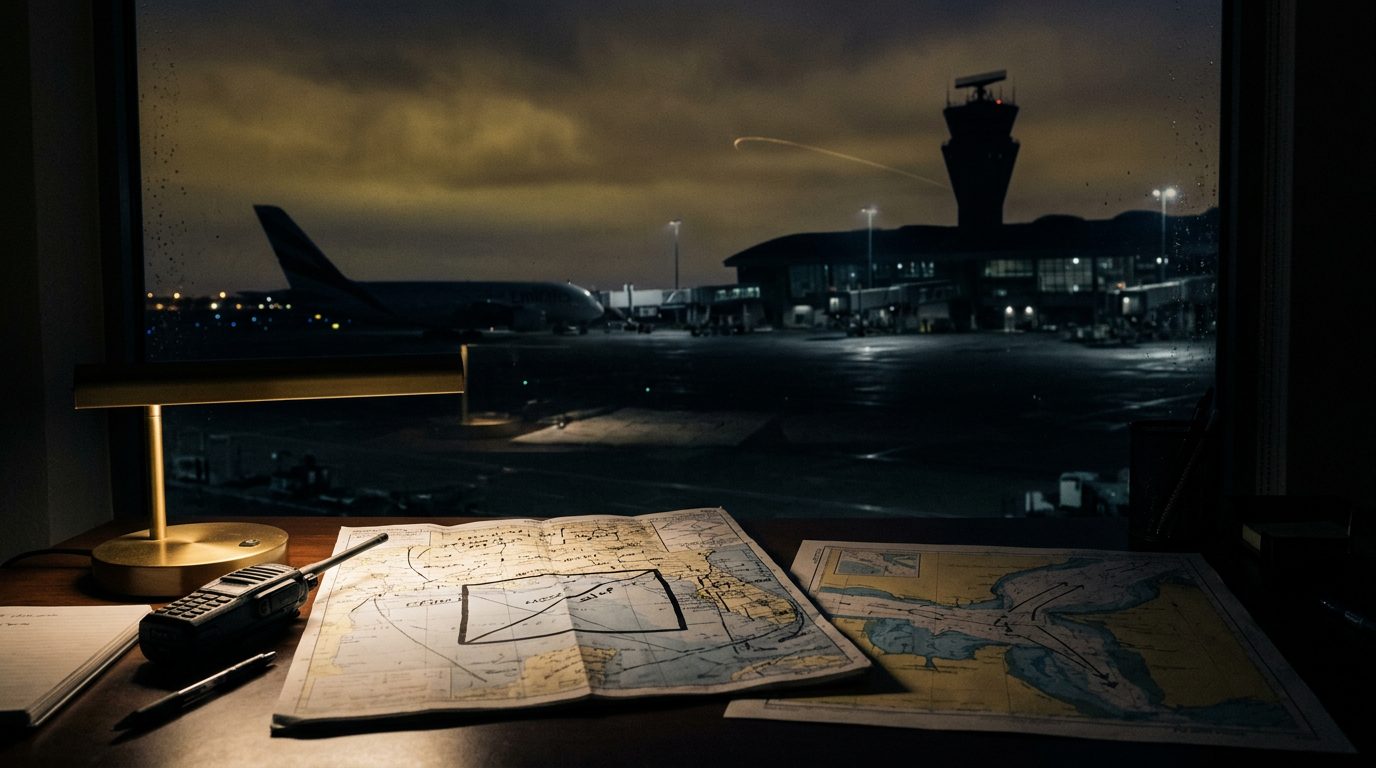
The window for routine Gulf movement has narrowed to almost nothing. EASA issued a Conflict Zone Information Bulletin on 14 July telling airlines to avoid the airspace of Bahrain, Kuwait, Qatar and the United Arab Emirates, plus the Gulf of Oman within the Muscat Flight Information Region west of 58 degrees east, at all altitudes. It runs until 29 July unless lifted earlier.
EASA's reasoning is blunt: repeated ceasefire violations, Iranian attacks on shipping and related US strikes, and the risk that active air-defence systems could mistake a civilian aircraft for a military target, with missile, drone and falling-debris hazards at all flight levels. Separate bulletins for Iran, Iraq and Lebanon run to 31 August.
The sea route is no better. The US blockade and the collapse in commercial transits mean the maritime corridor through Hormuz is effectively shut. For a protective team that leaves two of the region's primary movement corridors degraded at the same moment, air and sea, with the wider land picture already thin.
The working tradecraft for the next fortnight comes down to a few habits. Route around the advisory, not through it: assume Gulf-state overflight and the Muscat FIR corner are unavailable, and price the longer routing into timings and crew duty. Confirm the operator's own risk position, because an airline flying a route EASA has told it to avoid is a decision worth understanding before a principal is booked onto it. Hold a self-reliant fallback that does not depend on a scheduled flight or a calm transit. And watch the calendar, because the advisory carries a review point of 29 July, so build plans that survive either an extension or a sudden reopening.
The discipline is to plan every Gulf leg as if both the fast air route and the sea route are closed, then treat it as a bonus if one opens. Movement is still possible, but only degraded and deliberate, with a fallback that stands on its own.