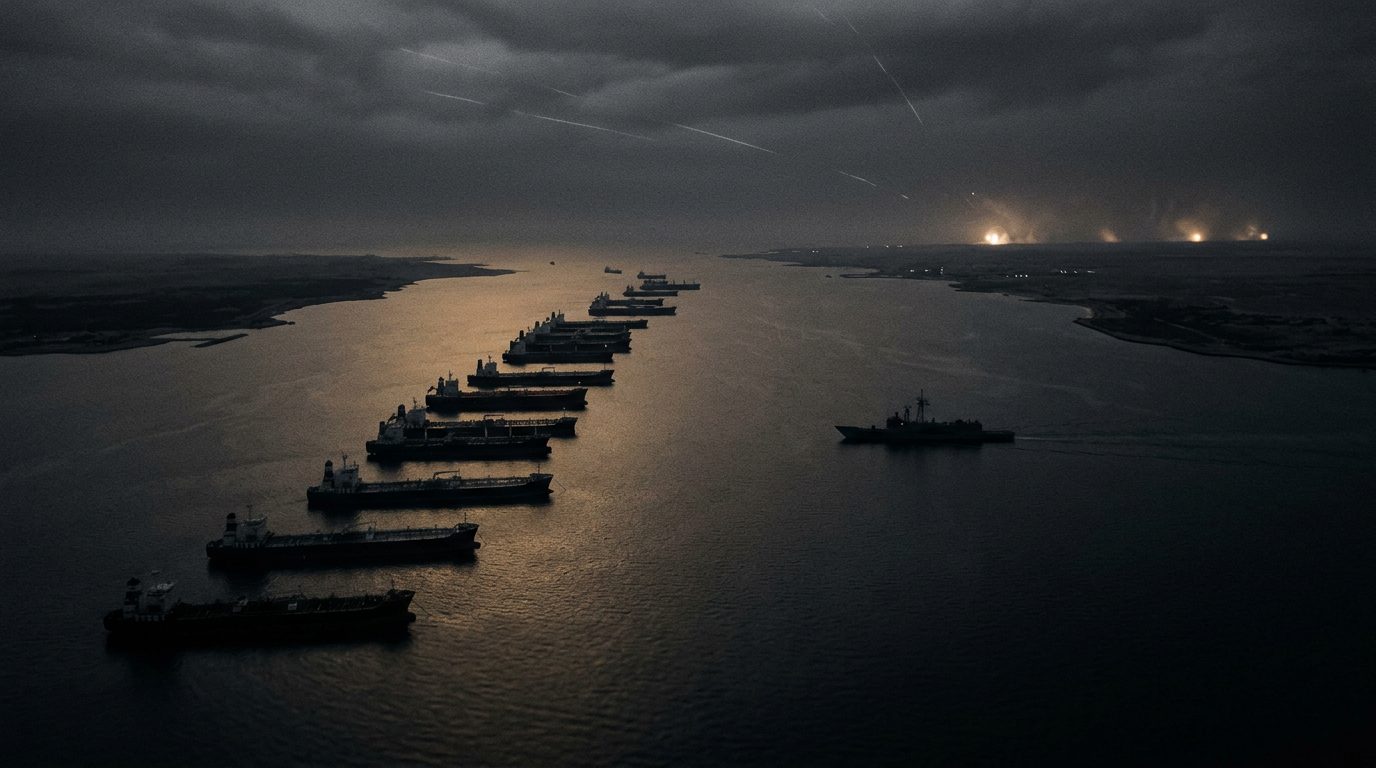
The standoff over the Strait of Hormuz has run into a second week of open strikes. Per NPR, the United States and Iran exchanged strikes on military and infrastructure targets on Saturday as the fight over the strait intensified. CENTCOM's campaign has now run across several rounds: US strikes have hit more than 300 sites in all, including around 140 in a single Saturday's wave, per Al Jazeera and CBS, aimed at Iranian air defence, coastal radar, and missile and drone capability.
The naval picture hardened on 14 July, when the US reinstated its blockade of Iranian ports and began enforcing it. Commercial traffic through Hormuz has collapsed. CBS reported only 34 vessels transited on 10 July, the lowest count since late June, and owners have kept ships out since. Iran says the strait is closed; the US says it stays open. In practice it is closed by risk.
Iran's answer has spread across the Gulf. Tehran has targeted US sites in several Arab states, with Bahrain, Kuwait, Qatar, Jordan and Oman all reporting incoming missiles or drones, and Jordan reporting four missiles shot down. Both sides accuse each other of breaking the mid-June understanding, which is now close to collapse.
The politics offer no quick exit. President Trump declared the ceasefire over earlier this month and reversed a short-lived plan to charge transiting ships a cargo fee. His negotiating team, led by Vice President JD Vance with Jared Kushner, Steve Witkoff and Marco Rubio, has kept talks going, and Iran has signalled it wants to keep talking, per Al Jazeera. No off-ramp is in sight.
For protective and maritime teams the planning picture is fixed for the coming week. Treat the blockade, live air-defence activity across the Gulf states, and a closed strait as hard constraints. Principals and crews staged through Doha, Dubai, Abu Dhabi and Manama sit inside an active threat ring, and a single political signal can move the risk in hours. Hold a self-reliant fallback that does not depend on a calm transit window or a scheduled flight.