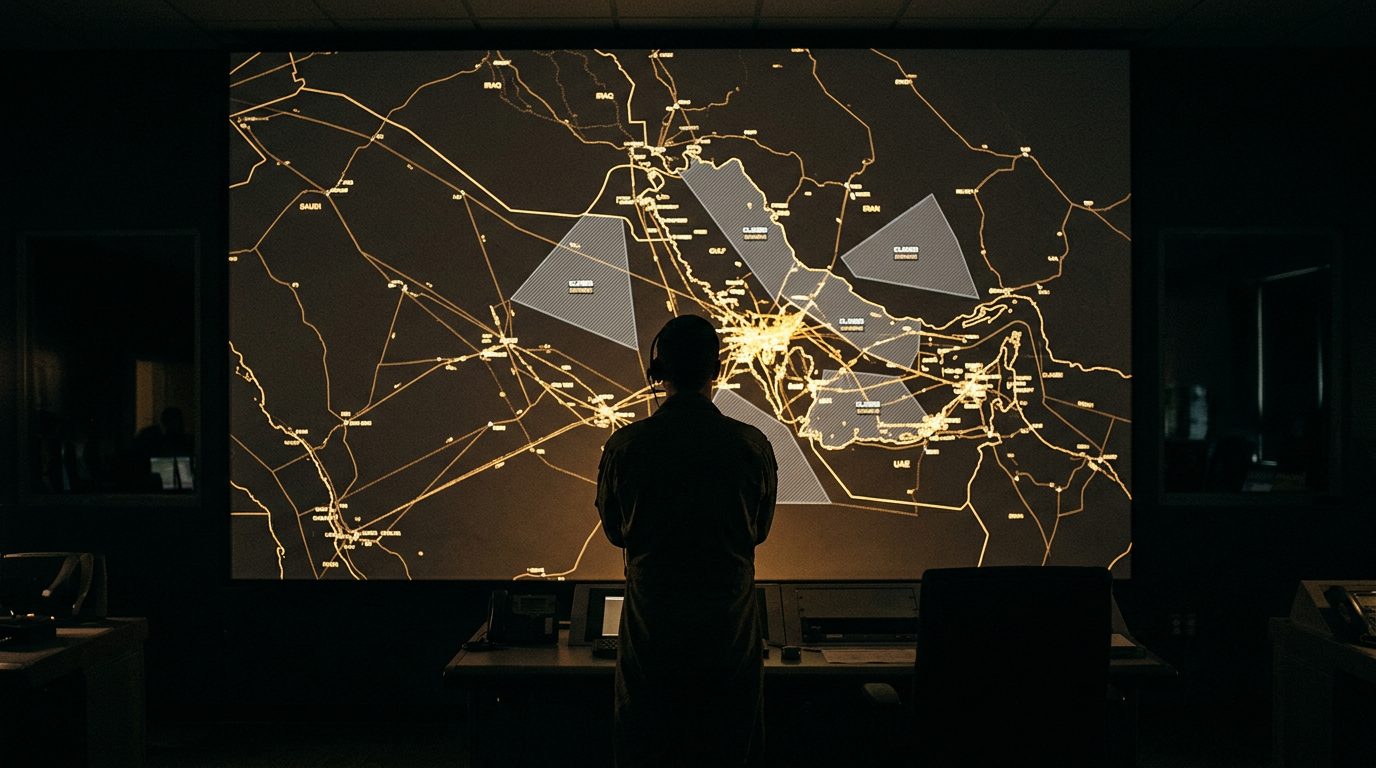
Iran has entered a week of state mourning for former Supreme Leader Ali Khamenei, and it is reshaping the operating picture across the Gulf. Open-source reporting indicates public ceremonies and processions run through the week across Tehran and Qom, and the Iraqi shrine cities of Najaf and Karbala, before burial at the Imam Reza shrine in Mashhad later in the week.
The immediate operator concern is airspace. Per Euronews, Tehran's airspace is partly closed from Friday and fully closed from Monday for the ceremonies. That removes routing options over the capital at the same time as the wider Gulf navigation picture is already degraded.
The turnout signals the posture. Al Jazeera reports representatives from more than 100 countries; Euronews counts at least eight heads of state or government among them, including Russia's Dmitry Medvedev as Vladimir Putin's special envoy, Pakistan's Prime Minister Shehbaz Sharif and army chief Asim Munir, and the Taliban's foreign minister. No European state was formally invited. Iran's military command has publicly warned the United States and Israel against any miscalculation during the mourning period.
The diplomatic track is on hold with it. The indirect US-Iran talks, the ones carrying the June ceasefire and the unresolved Strait of Hormuz routing dispute, are paused for the mourning period and are expected to resume only after the burial.
Operator implication: expect a hardened, higher-alert regional posture for the whole week and no diplomatic movement until it ends. Air movement into or over Iran is constrained by the Tehran closures and by the broader GNSS interference picture across the Gulf. For principals, crews and families in the region, keep contingency, war-risk cover and shelter and airspace fallbacks current, and treat this week as the highest-risk window before talks resume.