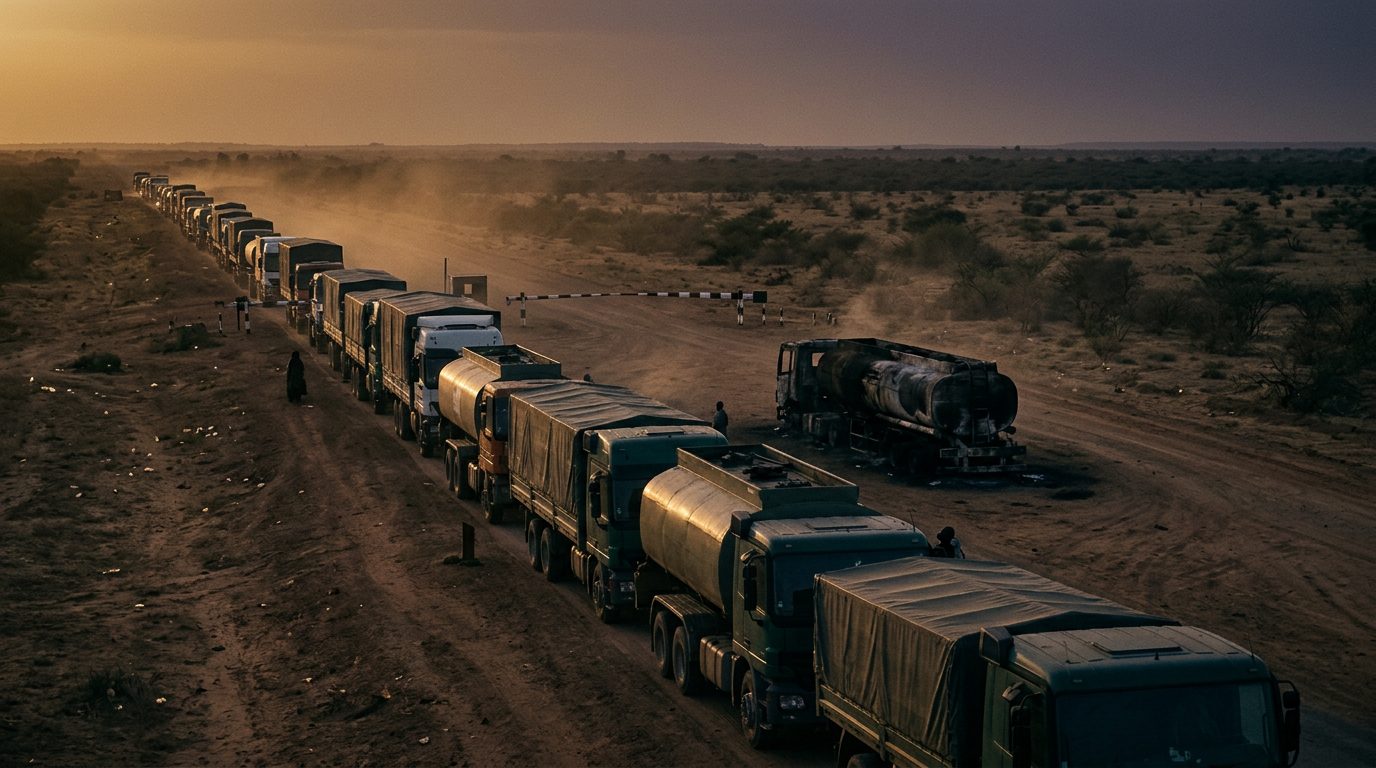
Mali sits at an elevated threat level driven not by a battle in the capital but by a blockade around it. The al-Qaeda affiliate JNIM has been choking fuel convoys into Bamako, first from September 2025 and reimposed in April 2026. Because Mali is landlocked and imports around 95% of its fuel by road from Senegal and Cote d'Ivoire, cutting those corridors starves the capital without a shot fired inside it.
More than 300 fuel tankers have been destroyed en route since the blockade began. Inside Bamako the effect is hours-long queues at filling stations and rationing that steers scarce fuel to military and government use. Western governments moved early: the US embassy urged Americans to depart Mali by commercial air in late October 2025, with the UK issuing similar guidance.
For operators the significance is the mechanism. This is a logistics siege, not a firefight, and fuel is the single point of failure. Any client footprint in Mali should treat ground movement, generator power and evacuation options as fuel-dependent and therefore fragile. Duty-of-care planning needs to assume commercial aviation and fuel availability can degrade with little notice, that the security envelope around the capital is thinner than the absence of city-centre fighting suggests, and that the trigger for a hard extraction may be a fuel line, not a gunfight. Watch the convoy corridors and the airport's fuel state as the leading indicators.