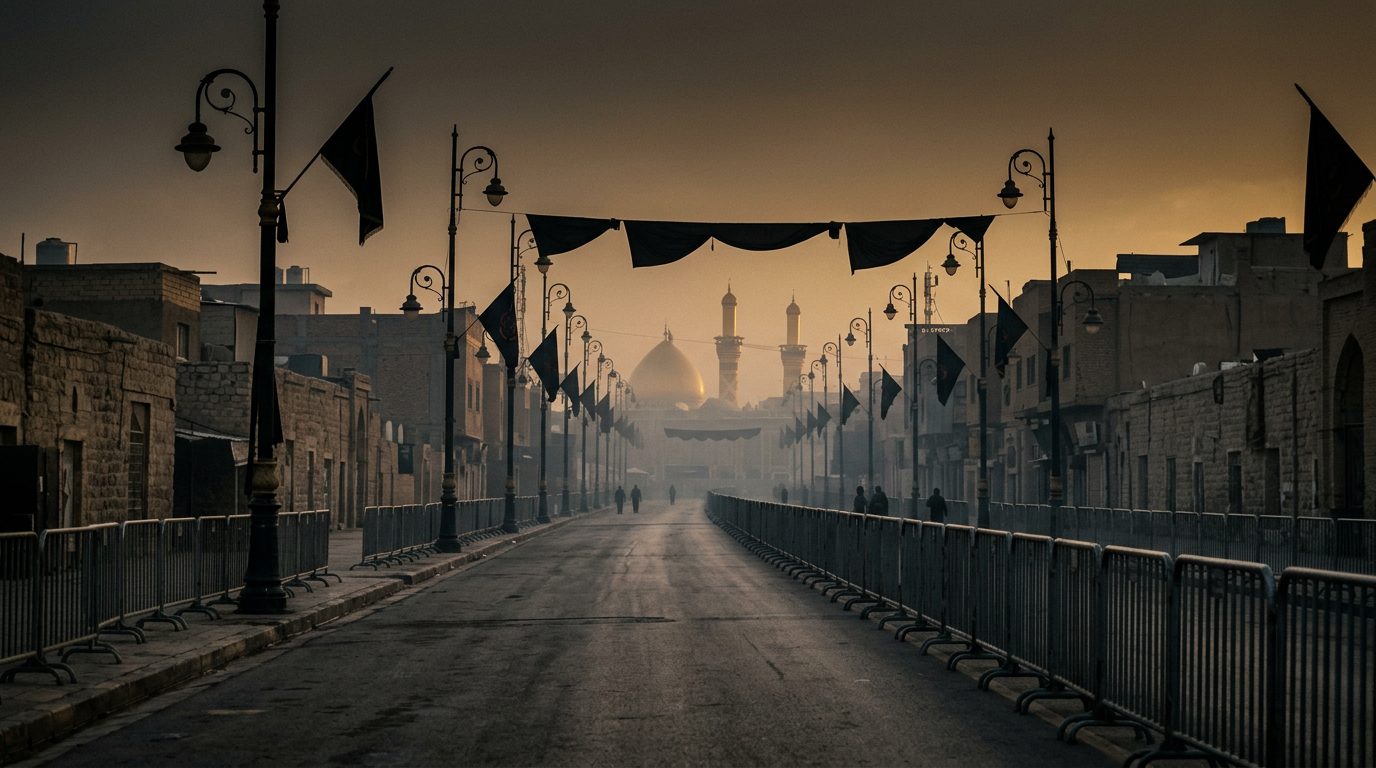
Iran's state funeral for Ali Khamenei ends today. After farewell ceremonies in Tehran and Qom and a two-day passage through the Iraqi shrine cities, the body returns to Iran for burial at the Imam Reza shrine in Mashhad, Khamenei's birthplace and one of Shia Islam's holiest sites (Wikipedia; Al Jazeera). Khamenei was killed on 28 February in a joint US-Israeli strike on the supreme leader's office in Tehran, and the ceremonies have run from 3 to 9 July.
The scale has been enormous. Open-source reporting put the Tehran procession on 6 July at twelve to fifteen million; the Iraq leg on 8 July drew what the Popular Mobilisation Forces estimated at more than 2.3 million into Najaf and far larger crowds in Karbala, along a six-kilometre route to the Shrine of Imam Ali. Across the whole week, estimates range from twenty to thirty million people (Wikipedia).
The threat picture around it has two layers. The immediate one is crowd density and movement friction: heavy road closures, transport restrictions and saturation security around Mashhad today and along the Iraqi corridor as the crowds disperse. The larger one is that this is happening as the Gulf war reignites — three tankers hit in Hormuz this week and US strikes on Iran overnight. Iraq remains at Level 4, "Do Not Travel," on the US State Department scale, and its position between Iran and the Gulf states makes it exposed to any wider escalation (US Department of State).
For operators: avoid the funeral cities and their approaches through the dispersal, treat any Iraq or Iran movement as high-risk against a live conflict backdrop, and hold contingency for airspace and border friction spreading regionally as the fighting resumes.