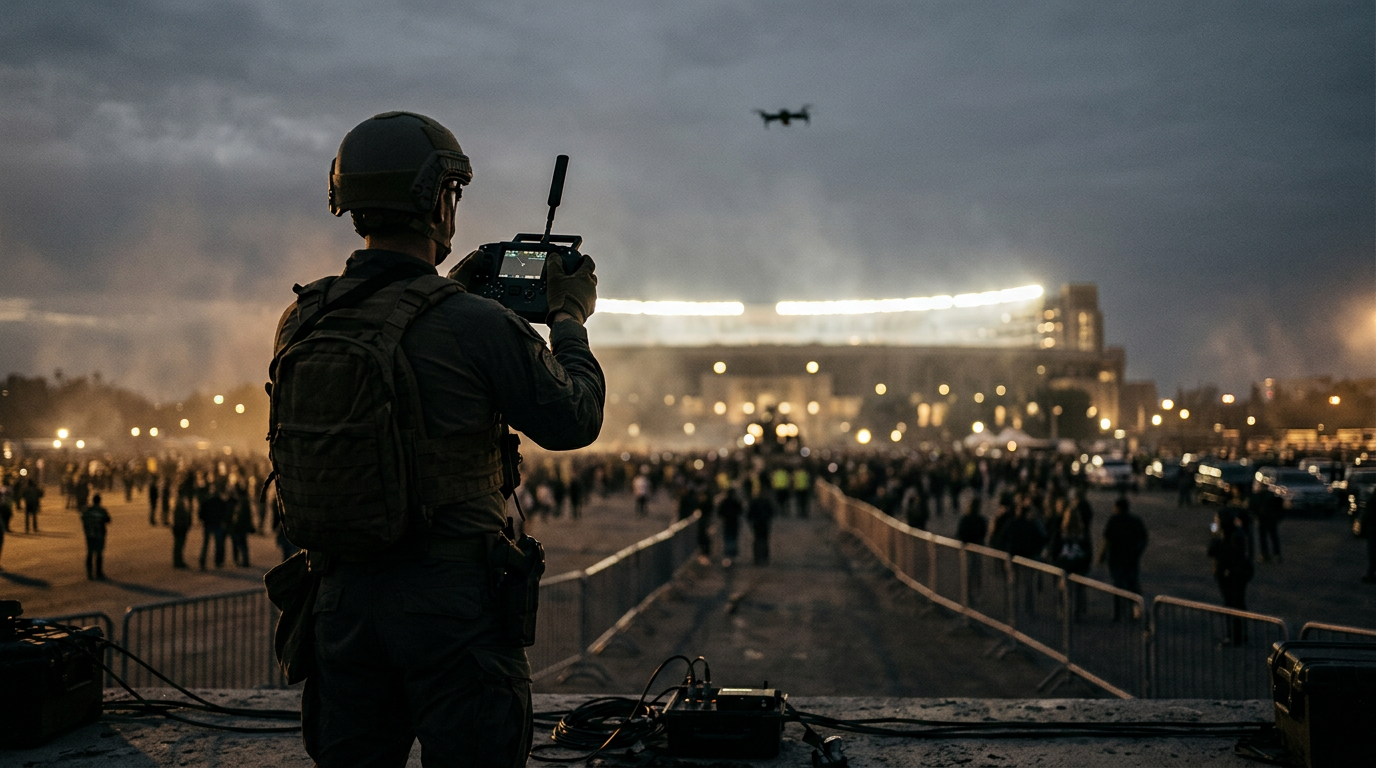
The 2026 World Cup has become the largest running trial of counter-drone security to date. Open-source reporting indicates US authorities have intercepted more than 300 drones entering restricted airspace near venues, a figure one security official described to ABC News as 'quite shocking'. The White House task-force lead says every match and every fan event has counter-drone mitigation in place.
The scale is federal. A 365-million-dollar programme covers the 104 matches across the US, Canada and Mexico, with 250 million from FEMA to the eleven US host states and 115 million from DHS for counter-drone technology at venues. Contracts have gone to specialist counter-UAS providers, and temporary flight restrictions ring each site: roughly a three-mile radius to 3,000 feet around stadiums and a one-mile radius to 1,000 feet around fan gatherings, with penalties up to 100,000 dollars and up to a year in prison for incursions.
The operational lesson is the signal-to-noise problem. Most of those 300-plus drones are hobbyists ignoring restrictions, not attackers, but every one has to be detected, tracked and assessed before it can be dismissed, and the volume itself degrades the picture. Detect-track-defeat only works if it can separate careless from hostile fast enough to act.
Operator implication: any protective team working near a venue, a fan zone or a VIP movement inside a TFR needs to deconflict its own airspace use and understand that counter-UAS assets are active and federally run. Do not fly your own drone inside a restriction. Brief teams that a drone overhead is far more likely to be a nuisance than a threat, but plan and rehearse for the case where it is not. The kit and the doctrine on show here are the template for major-event protection going forward.