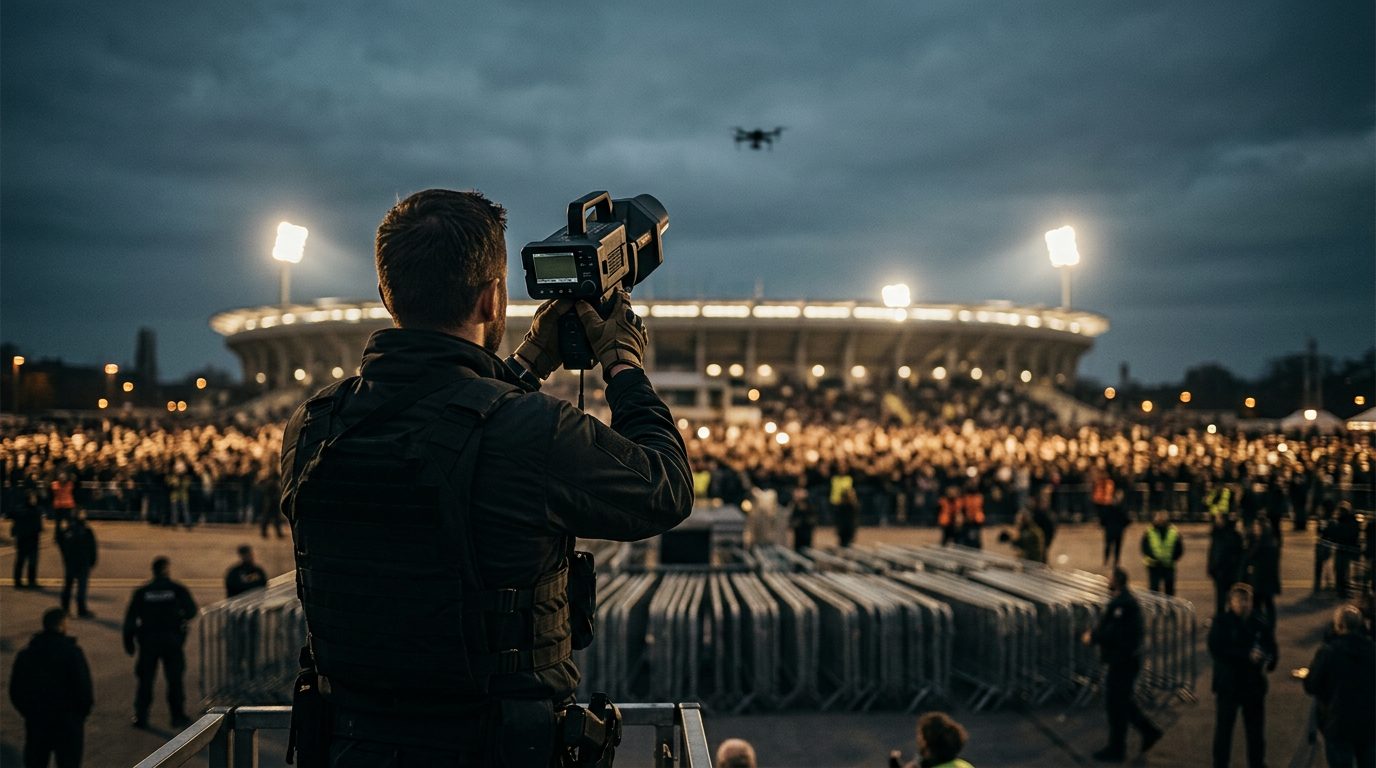
The 2026 World Cup enters its decisive week. The semifinals run at AT&T Stadium in Dallas on Tuesday 14 July and Mercedes-Benz Stadium in Atlanta on Wednesday 15 July, with the third-place match in Miami on 18 July and the final at MetLife Stadium in New Jersey on 19 July.
The signature security problem of this tournament has been small drones. As of early July the FBI and Department of Homeland Security had seized more than 600 across the US host cities and detected over 1,100, with more than 300 aircraft brought down or diverted without force. Atlanta, with 77 seizures, and Dallas, with 63, sit near the top of the table — the two cities now hosting the semifinals.
The restricted airspace is fixed: a 3-nautical-mile, 3,000-foot no-fly ring around each stadium, and a 1-nautical-mile, 1,000-foot ring around fan festivals. Enforcement runs through the FBI and DHS, backed by roughly 60 state and local officers certified for electronic drone mitigation; more than 300 aircraft have already been brought down or diverted without force. Bringing a drone down sits with those certified agencies — a private team at a venue detects, reports and integrates with the authority holder, it does not act alone.
For anyone moving a principal near a host city this week, the hazard is not the spectacular. It is access, road closures and crowd density around stadiums and fan zones as attendance peaks. The drone threat sits in the grey space outside the stadium ring — over car parks, transport hubs and fan festivals — where a single nuisance overflight can still stop a match or a movement. Plan routes around the closures, build in time, and keep principals clear of the pinch points.