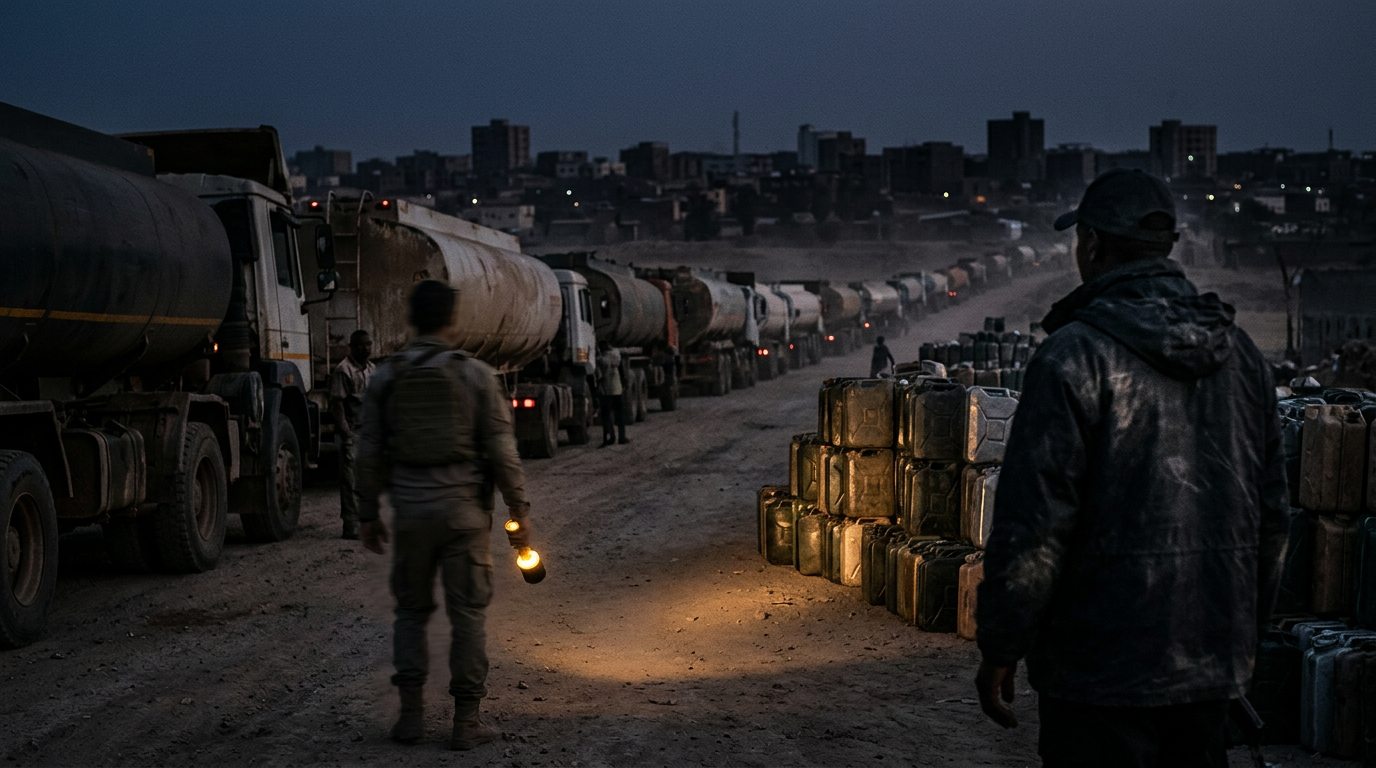
JNIM's fuel blockade on Mali has now held since September 2025. The al-Qaeda-linked group has burned more than 300 tankers on the supply corridors from Senegal and Cote d'Ivoire. Mali is landlocked and imports roughly 95% of its fuel by road, so cutting those routes chokes Bamako without a shot fired in the city.
The effects are visible. Open-source reporting describes long fuel queues, rationing that prioritises military and government use, and a capital noticeably darker at night from reduced power generation. Schools and universities closed for a period over the shortage. The junta has pushed escorted convoys through, delivering over a thousand tankers since late October, and named a general to run what local media call the fuel war. Russian Africa Corps and Turkish drone support has not broken the blockade. A convoy attack in early February reportedly killed at least 15 people.
The diplomatic signal is the one operators should weigh. In late October 2025 the US and UK told their nationals to leave Mali and drew down embassy staff, citing both the fuel crisis and a rise in kidnappings. As of June 2026 the US State Department still tells citizens not to travel and to hold a self-reliant departure plan that does not depend on government help.
For operators, Bamako has shifted from a guarded-but-functional hub to a city under siege conditions. Fuel scarcity degrades everything that matters for a move: vehicle availability, generator-backed comms, hospital capacity and the responsiveness of any local security force. The convoy routes are the killing ground, so overland movement to and from the capital carries direct attack risk, and the kidnap threat to foreign nationals is rising.
Treat Mali as do-not-travel. If a task is genuinely unavoidable, it needs a self-sufficient fuel and power plan, no reliance on local convoys, a hardened airport-to-site profile, and an extraction plan built around commercial aviation while it still runs.