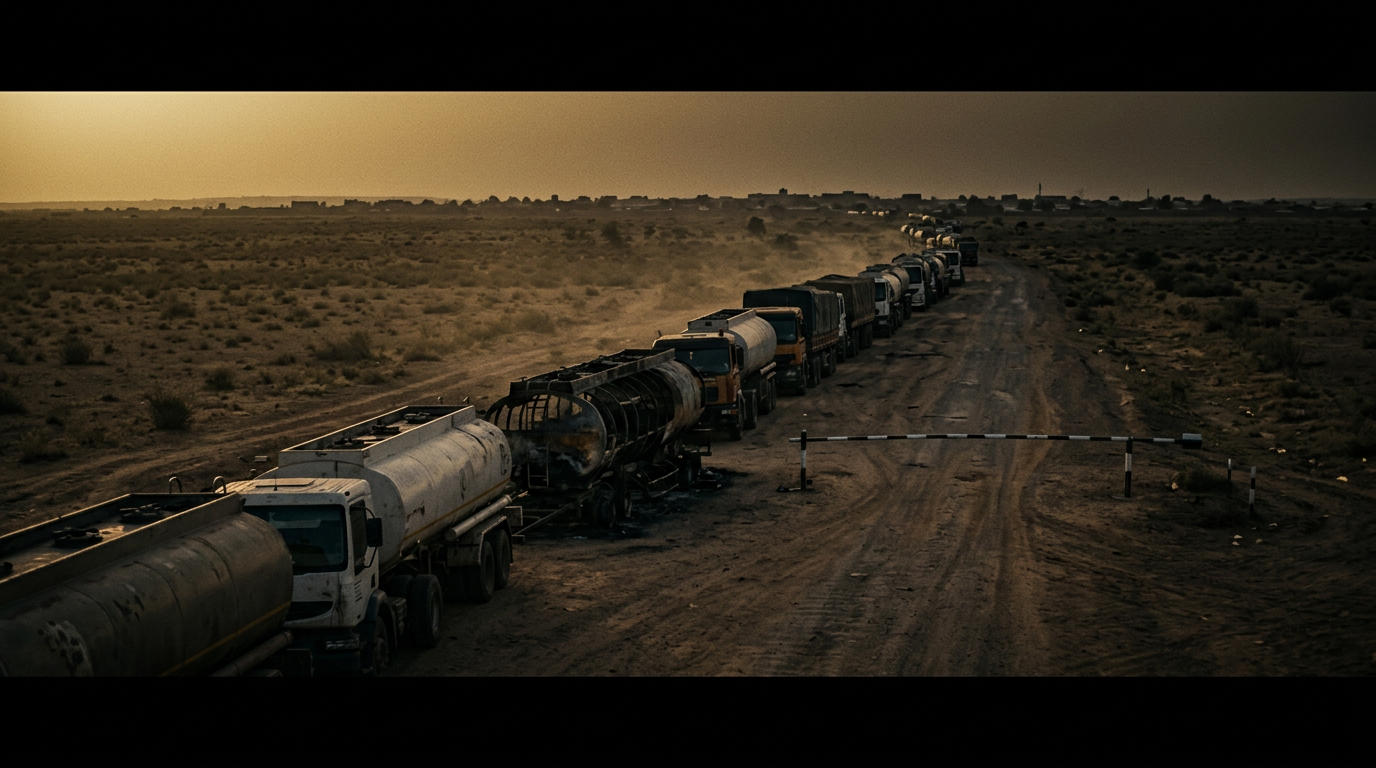
Mali's capital is being strangled without a shot fired inside it. Open-source reporting indicates the al-Qaeda-linked group JNIM has run a fuel blockade on southern Mali since 3 September 2025, ambushing tanker convoys and torching more than 300 vehicles. Mali is landlocked and imports roughly 95% of its fuel by road from Senegal and Côte d'Ivoire, much of it along National Road 1 through Kayes — so cutting the roads chokes Bamako directly.
The effect is visible. Filling-station queues, fuel rationed toward military and government use, schools and universities shut for a fortnight from late October 2025, and satellite imagery showing a capital measurably darker at night. The army has forced armed convoys through — more than a thousand tankers escorted in since late October — but at cost: a convoy attack near the Senegalese border in early February 2026 killed at least 15.
The wider Sahel picture is deteriorating in step. JNIM killed Mali's defence minister, General Sadio Camara, in a suicide vehicle bombing at his residence in Kati on 25 April 2026, and struck the airport in neighbouring Niamey, Niger, on 18 June. Against that, the UN Security Council is due to hold an open briefing followed by closed consultations on West Africa and the Sahel this month, with the UNOWAS Special Representative Leonardo Santos Simão expected to brief.
Operator implication: treat Bamako as a functioning but besieged capital where fuel, power and movement are all constrained and unpredictable. The risk is concentrated on the overland resupply routes — the Kayes corridor and the Senegal and Côte d'Ivoire borders — where ambush and kidnap exposure is highest. Ground movement and fuel logistics are the planning problem, not the city centre; build in fuel resilience, vetted local drivers and route alternates, and do not expect the UN session to change conditions on the ground in the near term.