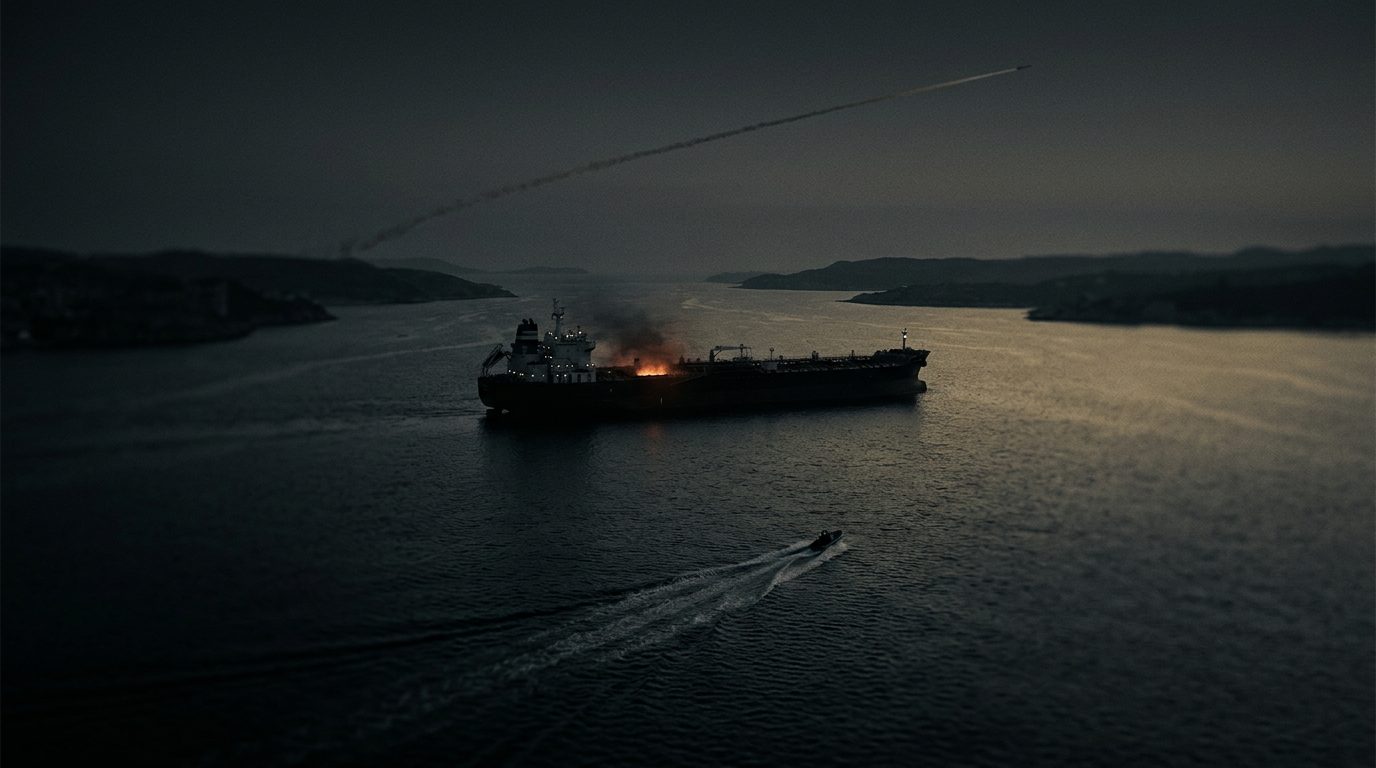
The Gulf's quiet is finished. Three commercial tankers were attacked in the Strait of Hormuz on Tuesday, and by the following day the interim understanding that had held an uneasy line since mid-June was being called over.
Open-source reporting names the Al Rekayyat, hit by a projectile around eight miles east of Limah off Oman, which caught fire with no casualties; a second vessel struck by a projectile as it left the strait some sixteen miles off the UAE coast; and a third hit by a drone off Oman's Musandam Peninsula (Washington Times). All three attacks left crews safe, but the pattern — projectiles and a one-way drone against shipping at the chokepoint — is the one operators have been planning against for months.
Washington's response ran on two tracks. US Central Command launched retaliatory strikes on Iranian targets, with Iranian state media reporting explosions in the south (Washington Times). And the US Treasury revoked the June authorisation that had let Iran export oil legally, giving existing transactions until 17 July to close (Washington Times). At the NATO summit in Ankara the same day, President Trump declared the interim memorandum with Iran over and NATO Secretary-General Mark Rutte called the US strikes "absolutely necessary," citing Iranian ceasefire violations (Al Jazeera). War-risk underwriters read it the same way, with some advising owners to pause Hormuz transits (Insurance Journal).
The funeral calendar sits underneath all of it. Iran buries Ali Khamenei at the Imam Reza shrine in Mashhad today, closing a week of state mourning; the diplomatic track that was paused around it now has nothing obvious to resume to. What looked, seven days ago, like a decision week that might reopen the strait has instead resolved into renewed exchange of fire.
For operators, treat the Gulf as an active conflict environment again, not a tense lull. Hormuz maritime and Gulf air movement should be planned on the assumption of further strikes and continued shipping attacks, not normalisation. Expect airspace closures and diversions around southern Iran and the strait, degraded satellite navigation across the whole basin, and short-notice changes to what insurers will cover. Anything you can defer out of the Gulf this week, defer.