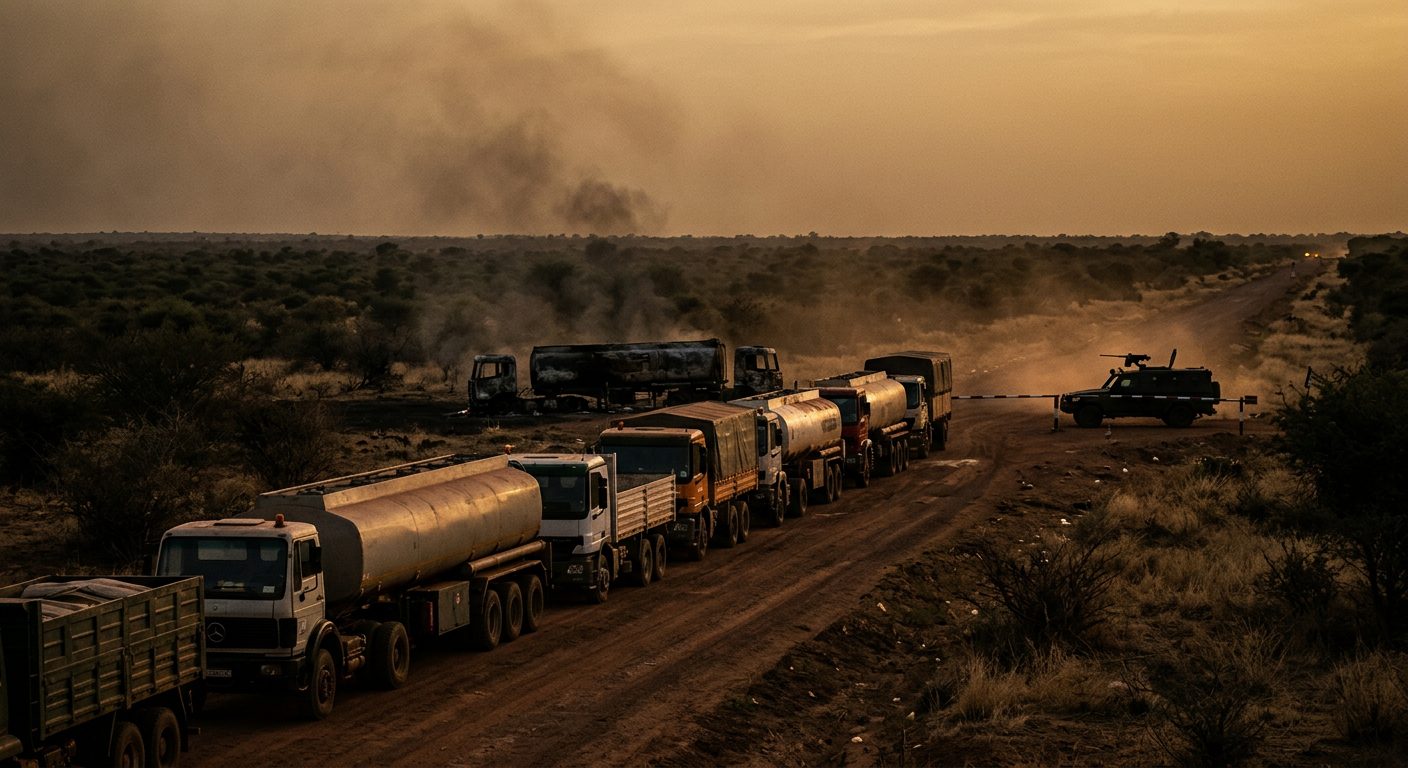
The economic siege of Bamako is one of the most effective insurgent campaigns running anywhere, and it has not broken.
Since September 2025, the al-Qaeda affiliate JNIM has blockaded the fuel routes into landlocked Mali, which imports roughly 95% of its fuel by road, chiefly from Senegal and Cote d'Ivoire. More than 300 fuel tankers have been destroyed on the import routes from Senegal, Cote d'Ivoire and Guinea. The effect on the capital has been severe: schools and universities closed for a fortnight from late October, satellite imagery shows Bamako visibly darker at night, and power generation and farm machinery have been squeezed.
The government has not been passive. The army has escorted convoys through, moving more than a thousand tankers into Bamako since late October, and the junta appointed a general to run the response. Russian Africa Corps personnel and Turkish drones have been committed. None of it has lifted the blockade. JNIM sets the tempo — choosing when to let fuel through and when to burn it — and has kept pressure within day-trip range of the capital.
For operators, Mali is a hard environment and getting harder. Anyone with people or interests there — mining, energy, NGO, diplomatic — should assume fuel supply is unreliable, road movement outside the capital is high-risk, and any convoy is a potential target. Contingency fuel, tight movement control, and a credible evacuation trigger are not optional. The strategic question — whether a capital can be strangled without a shot fired inside it — is being tested in real time.