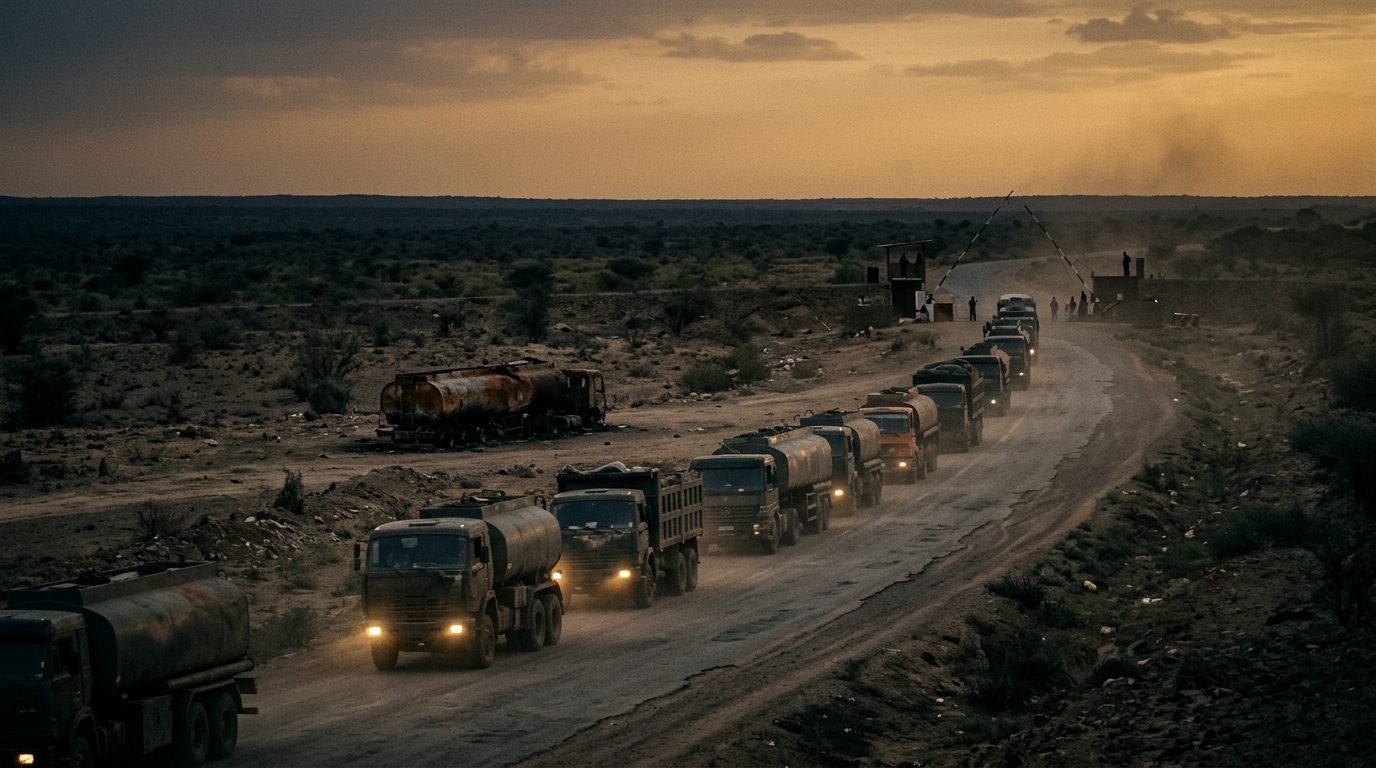
After months of strangling Mali's capital, the al-Qaeda-linked group JNIM's fuel blockade of Bamako appears to have eased. Open-source reporting indicates fuel convoys are moving again and daily life is resuming in the city — a marked change from the peak of the siege, when queues, blackouts and shuttered services defined it. What is missing is an explanation: residents and analysts say it is unclear how the blockade was lifted, or how long the calm will hold.
The context is important because it is a pattern, not a one-off. JNIM began choking Bamako in September 2025 by burning fuel tankers on the roads into a landlocked country that imports the overwhelming majority of its fuel by road from Senegal and Côte d'Ivoire. The aim was never to storm the capital but to strangle it — and to break a junta that turned to Russia after expelling France. The blockade eased earlier in 2026, then JNIM re-imposed a full blockade on 28 April. An easing has come and gone before.
Western guidance has not moved with the traffic. The US State Department still advises against all travel to Mali and tells citizens to hold a self-reliant departure plan that does not rely on government help. That gap — improving ground conditions, unchanged official posture — is itself the signal: no one with visibility is treating this as resolved.
For operators, the working assumption should be permissive-but-reversible. Fuel is the single point of failure for any movement plan in Bamako: it governs vehicle availability, generator-backed communications, hospital capacity and the responsiveness of local security. A window in which convoys move is the time to pre-position fuel and consolidate, not to relax posture. Keep a self-reliant overland and air departure option live, watch the Kayes corridor and the western and southern approaches where ambush and landmine incidents have clustered, and treat any renewed tanker-burning on the supply routes as the leading indicator that the siege is back on.