The 2026 World Cup has entered its knockout run-in, and from the quarter-finals the whole tournament sits on US soil. The four quarter-finals are being played from 9 to 11 July across Foxborough, Inglewood, Miami Gardens and Kansas City; the semi-finals fall on 14 July in Arlington, Texas, and 15 July in Atlanta; the final is on 19 July at MetLife Stadium in New Jersey (Wikipedia). A group stage spread across three countries has concentrated into a run of high-profile US fixtures.
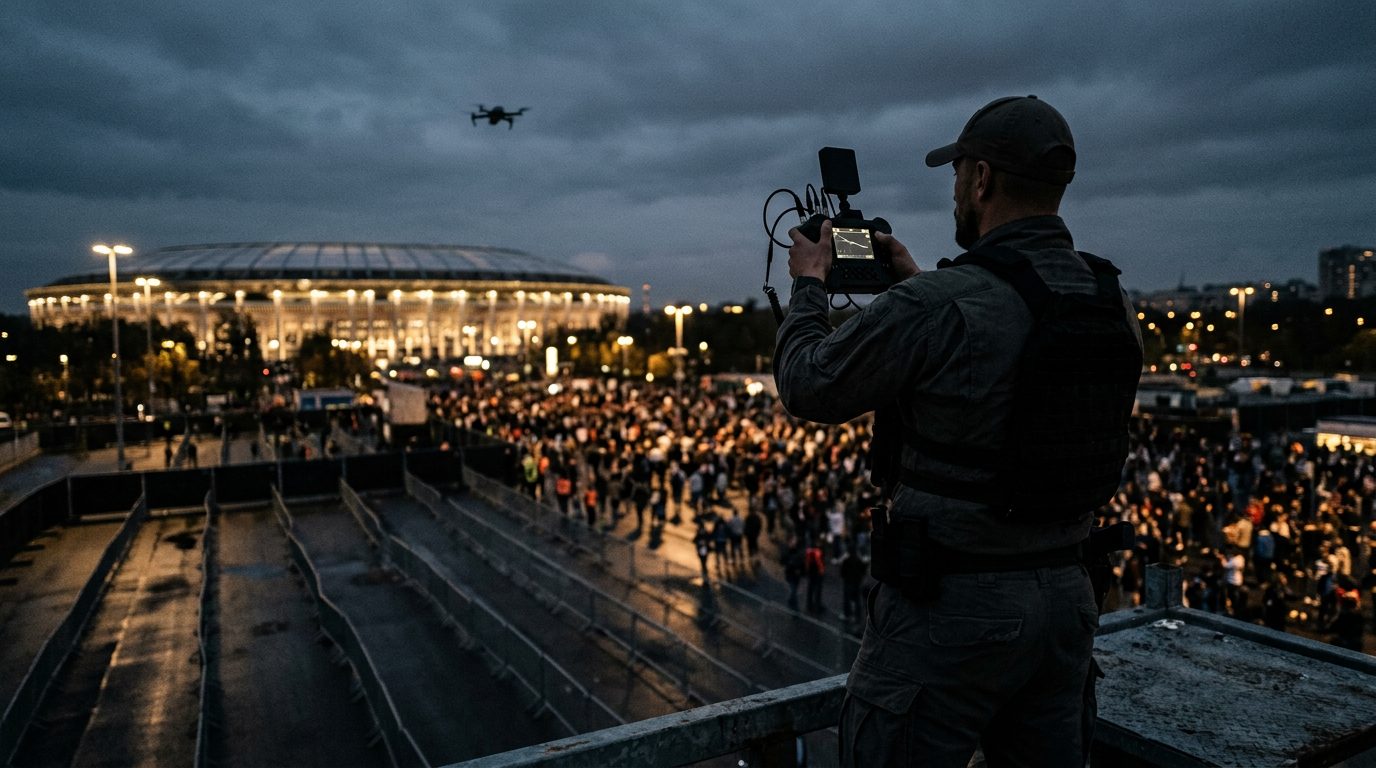
Drones remain the problem the security enterprise has not solved. Counter-UAS is in place across US venues, split between the Department of Homeland Security — covering eight stadiums with Customs and Border Protection and the Coast Guard — and the FBI at three more, with a dedicated FBI counter-UAS training centre at Redstone Arsenal that has run state and local officers through the capability (DroneLife). DHS Secretary Markwayne Mullin told Congress on 3 June the department is "struggling with every single day," and flagged the soft space — fan festivals and the ground outside the security perimeter — as the real gap.
As the tournament narrows to fewer, bigger US matches, three things sharpen. The target set becomes more concentrated and more symbolic. The soft-area problem Mullin named grows, because the crowds outside the bowl — fan zones, transit hubs, watch parties — swell for the latter rounds. And the coordination seams between federal counter-drone assets and local law enforcement carry more load exactly when they matter most.
For teams working the run-in — protective details, venue security, corporate hospitality — the perimeter is the easy part; the exposure sits in the grey space around it. Plan principal movement to minimise time in fan-zone and transit choke points, treat the counter-drone bubble as venue-specific rather than assumed everywhere, and coordinate early with the local law-enforcement layer that owns the soft space. The kit is deployed; the friction is in the seams over who owns what.